


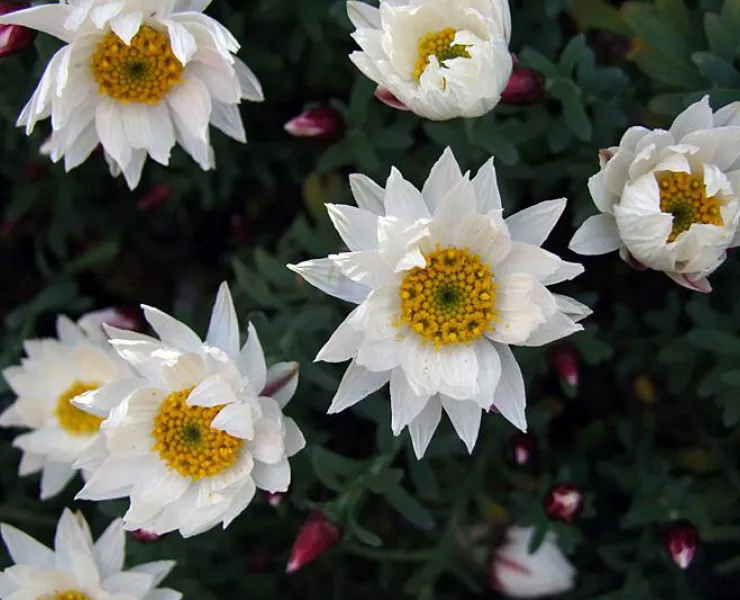
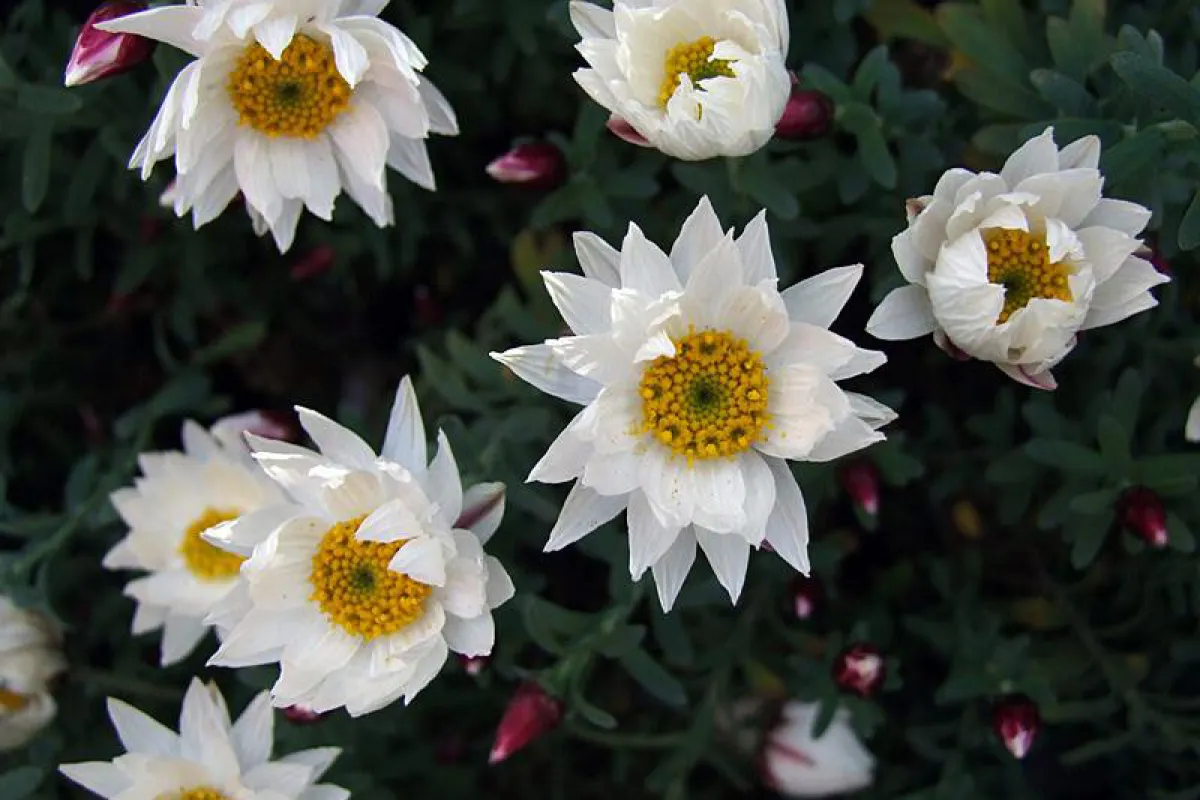
What appear to be white petals are actually long-lasting papery bracts around the small yellow central flowers. © The University of Melbourne
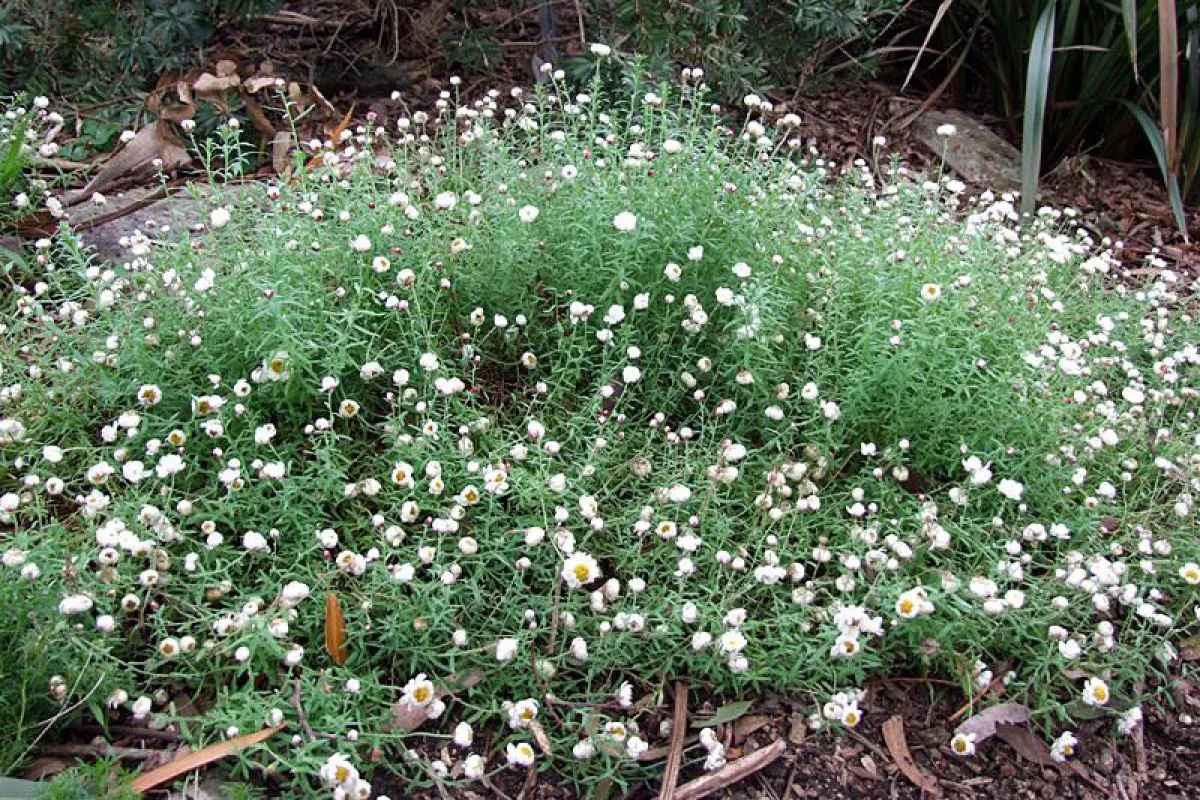
Rhodanthe anthemoides forms a soft, rather sprawling mound. © The University of Melbourne
What appear to be white petals are actually long-lasting papery bracts around the small yellow central flowers. © The University of Melbourne
Rhodanthe anthemoides forms a soft, rather sprawling mound. © The University of Melbourne
Plant growth form and habit: A small, variable evergreen perennial herb. Some variants are tufting with upright stems.
Natural distribution: Eastern Australia, including Vic, Qld, NSW, Tas, SA, from alpine herbfields to near coastal areas.
Indigenous to greater Melbourne: No
Height category: 0-0.5m
Dimensions (height and width): 0.3 m x 0.3-0.6 m
Landscape features: Fragrant flowers/foliage
Flowering: White, papery 'everlastings'. September to February. Has foliage with chamomile fragrance.
Typical growth rate: Fast
Light: Full sun, Partial sun
Drought: Average
Waterlogging: Poor
Maintenance and cultivation notes: Better in richer soils, pruning after flowering maintains density although some forms tolerate hard pruning more than others. Some caution is advised: tufting variants with upright stems usually do not respond well to hard pruning. Possibly not a long-lived plant. Selections such as 'Paper Baby', 'Paper Cascade' and 'Sunray Snow' usually perform well for 3 to 5 years. Flowerheads can be affected by Botrytis cinerea which may extend to stems.
Green roof suitability: Irrigated 10-20 cm depth, Irrigated > 20 cm depth
Bees and butterflies nectar and pollen source: Attractive to native bees, particularly Halictidae species such as Homalictus and Lasioglossum sp., butterflies, hoverflies, and other nectar and pollen foraging insects.
Butterfly larval host plants: Larval food plant for Australian painted lady (Vanessa kershawi).
Birds: Provides food for larvae eating birds such as the willie wagtail, which feed on the larvae of Vanessa kershawi.
Benefits: Nectar and pollen, Butterfly (caterpillar) host, Birds (food source)
Availability: Victorian Indigenous Nurseries Co-operative (VINC), Western Plains Flora, Goldfields Revegetation Native Nursery, Kuranga Native Nursery (availability as of June 2017)
Typical horticultural uses: Produces a vibrant annual floral display. Useful for edging and wildflower gardens. Suitable for green roofs.

