


Smoking is a major cause of preventable death and a leading cause of avoidable chronic illness and hospitalisation from conditions including cancer and cardiovascular disease. There is no safe level of exposure to tobacco smoke, including second-hand smoke.
E-cigarettes, also known as vapes, can contain up to 200 toxic chemicals, including those present in paint stripper and weed killer. These substances can cause cancer and impair brain function.
Melbourne is the first city in Australia to have a comprehensive framework to protect the community from the harms of smoking and vaping. Find out more below:
Further information on the community consultation process on the policy and outcomes can be found on Participate Melbourne External link.
The development of this policy was supported by the Partnership for Healthy Cities – an initiative of Bloomberg Philanthropies, the World Health Organization and Vital Strategies.
Image

|
Image

|
Image

|
Smoke-free areas
All levels of government have a responsibility to protect, promote and improve health and wellbeing.
The Tobacco Act 1987 External link (the Tobacco Act) is a key piece of Victorian Government legislation that regulates smoking and vaping in public places, including the sale and display of tobacco and vaping products.
In addition to state tobacco laws, the City of Melbourne has the authority to prohibit smoking and vaping in prescribed smoke-free areas under the Activities Local Law 2024.
The City of Melbourne has been successfully implementing smoke-free areas since 2013. Following the pilot of a small CBD laneway which received strong community support, there are now 16 smoke-free areas across the municipality.
Under City of Melbourne’s local law, the definition of ‘smoking’ includes e-cigarettes (or vaping), therefore both smoking and vaping are banned in City of Melbourne smoke-free areas. An education first approach is taken, however non-compliance may result in fines or prosecution.
| Smoke-free area | Location | Venue type | Legislation |
|---|---|---|---|
| Queen Victoria Market | Queen Street, Melbourne VIC 3000 | Public space | Council |
| QV Village | QV Village 278-300 Swanston Street, Melbourne VIC 3000 | Public space | Council |
| The Causeway | The Causeway between Bourke Street and Little Collins Street, Melbourne VIC 3000 | Road | Council |
| Howey Place | Howey Place from Little Collins Street, Melbourne VIC 3000 | Road | Council |
| Equitable Place | Equitable Place between Little Collins Street and Collins Street, Melbourne VIC 3000 | Road | Council |
| Block Place | Block Place from Little Collins Street, Melbourne VIC 3000 | Road | Council |
| Goldsbrough Lane | Goldsbrough Lane between Bourke Street and Little Bourke Street, Melbourne VIC 3000 | Public space | Council |
| The Tan | Royal Botanic Gardens Alexandra Avenue Melbourne VIC 3004 | Running track | Council |
| Princes Park Running Track | Princes Park 200-590 Royal Parade, Carlton North VIC 3054 | Running track | Council |
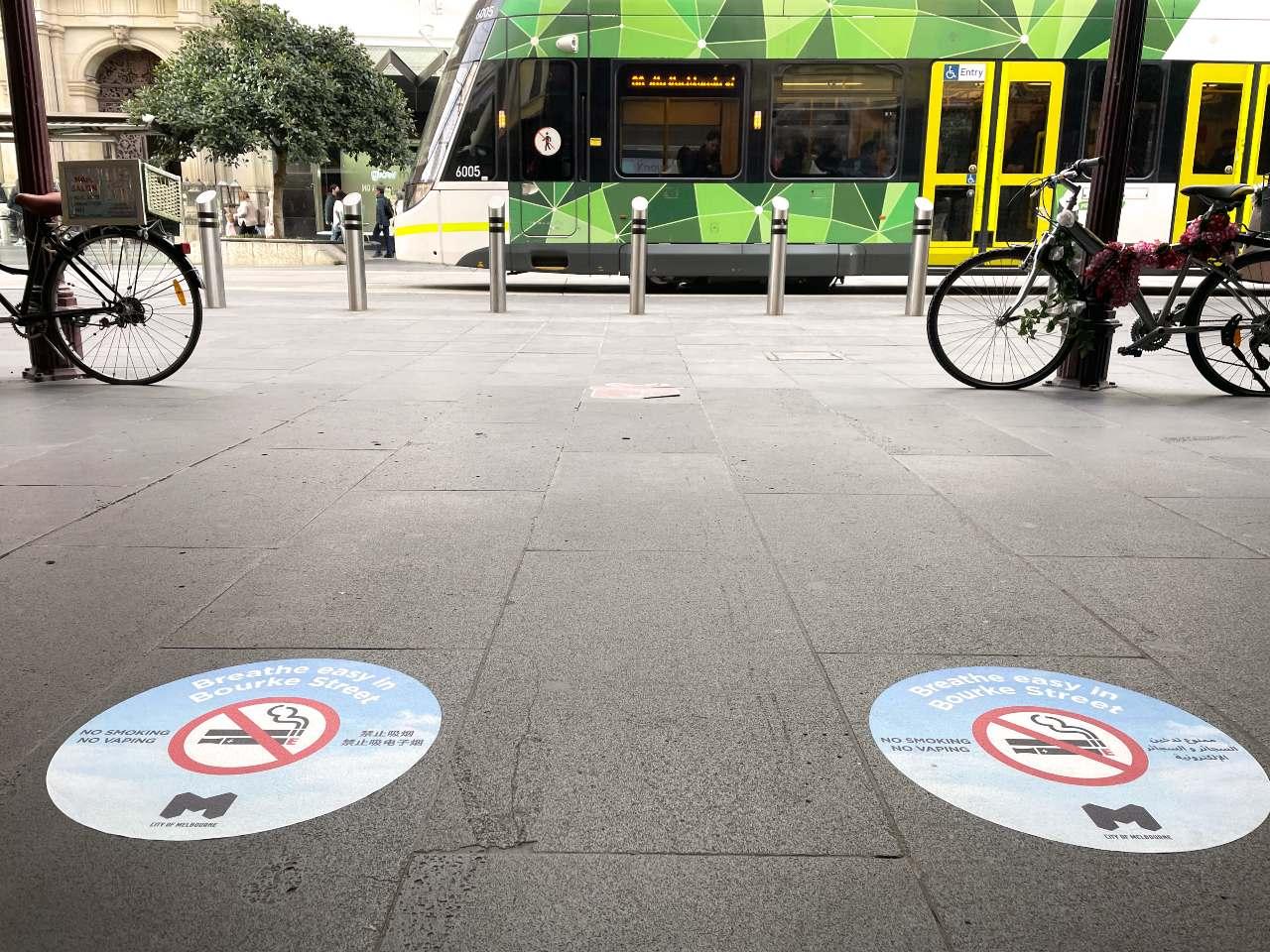
| Bourke Street | Bourke Street between Elizabeth Street and Russel Place/La Trobe Place, Melbourne VIC 3000 | Road and footpath | Council |
| Fulham Place | Fulham Place from Flinders Lane, Melbourne VIC 3000 | Road | Council |
| Collins Way | Collins Way from Little Collins Street, Melbourne VIC 3000 | Road | Council |
| McKillop Street | McKillop Street between Bourke Street and Little Collins Street, Melbourne VIC 3000 | Road | Council |
| Market Street Park | 431 Collins Street, Melbourne VIC 3000 | Public space | Council |
Smoke-free areas support the community in the following ways:
- Protect community from second-hand smoke and aerosol.
- Reduce uptake of smoking and vaping behaviours in children and young people by modelling non-smoking and non-vaping behaviour.
- Provide a supportive environment for people who smoke or vape and who are trying to quit or have recently quit.
- Reduce tobacco and e-cigarette related litter.
- Improve public amenities.
Resources for creating smoke-free areas
To create a smoke-free area, the City of Melbourne conducts extensive face-to-face and online engagement with businesses, residents and people visiting the areas to shop and dine. We carefully consider all feedback and submissions before prescribing an area smoke-free. Decisions on smoke-free area proposals are made at a Future Melbourne Committee meeting. Read more about council and committee meetings and reports.
The City of Melbourne has partnered with Quit Victoria to develop resources to support other local governments who are looking to implement smoke-free areas. These resources include a guide on how to create a smoke-free area, and a map of smoke-free Victoria External link.
To find out more about how the City of Melbourne endorses a smoke-free area, please read through the guide below.
Report smoking and / or vaping in a smoke-free area
- outdoor areas at hospitality and food venues during the times food is available
- food fairs, organised outdoor events including community or street festivals
- entrances to indoor children’s play centres, public hospitals and registered community health centres
- entrances to public buildings including courts, police stations, public hospitals and certain Victorian Government buildings
- the grounds of, and entrances to, childcare centres, kindergartens, preschools and primary and secondary schools
- outdoor recreational areas, including playground equipment, skate parks and sporting venues during under-age sporting events
- outdoor areas of public swimming pools
- patrolled beaches
- enclosed workplaces
- train stations, tram stop platforms and tram and bus shelters
- under-age music or dance events.
Smoking and vaping status in the City of Melbourne
Social Indicator Survey (CoMSIS) reveals that the percentage of residents in the City of Melbourne who are current smokers has increased from 12.5 per cent to 16.6 per cent between 2020 and 2025. Current vapers have also increased from 12.5 per cent to 13.4 per cent from 2022 to 2025.
| Smoker status | 2020 | 2022 | 2023 | 2024 | 2025 |
| Daily smoker | 7.9% | 5.5% | 4.5% | 7% | 6.8% |
| Occasional smoker | 4.6% | 9.1% | 10.2% | 8.5% | 9.8% |
| Current smoker (daily and occasional) | 12.5% | 14.6% | 14.7% | 15.5% | 16.6% |
| Ex-smoker | 23% | 21.2% | 20.8% | 21.4% | 21.1% |
| Non-smoker | 63.1% | 64.0% | 64.6% | 63.1% | 62.3% |
| Vaper status | 2022 | 2023 | 2024 | 2025 |
| Daily vaper | 4.1% | 4.5% | 4.1% | 5.2% |
| Occasional vaper | 8.1% | 8.0% | 7.6% | 8.2% |
| Current vaper (daily and occasional) | 12.5% | 12.5% | 11.7% | 13.4% |
| Ex-vaper | 5.9% | 7.4% | 10.5% | 10.4% |
| Non-vaper | 81.6% | 80% | 77.8% | 76.2% |
More information

