


You can compose music for the Federation Bells using your own MIDI sequencer or Digital Audio Workstation (DAW).
Download the toolkit below, open Kontakt in your host software such as Ableton, Cubase, Logic, or ProTools and then load the Kontakt patch. If you’re using Ableton, download the sampler below and add it to a MIDI channel to get started.
If you are using an alternate sampler, you can use the files in the ‘audio’ folder and map the samples to your keyboard as shown in the accompanying Technical Information (PDF 97 KB). In this document, the first column refers to the bell number and the next column to the corresponding MIDI note. It is important that these are mapped correctly.
Patches and manuals
Note: Samples are not included in this NN-XT download, please use the samples from the Kontakt patch and place with the patch in a sub-folder named 'Fed Bells Samples'.
Bell sample player
Once you have created a MIDI file, you can hear it in a virtual spatial environment with the following sample player. You will need to load the library of bell samples below into the sample player.
Submit your composition
Email your MIDI 0 file along with your contact details to fedbells@melbourne.vic.gov.au for your composition to be played at Birrarung Marr.
Pitch and tuning
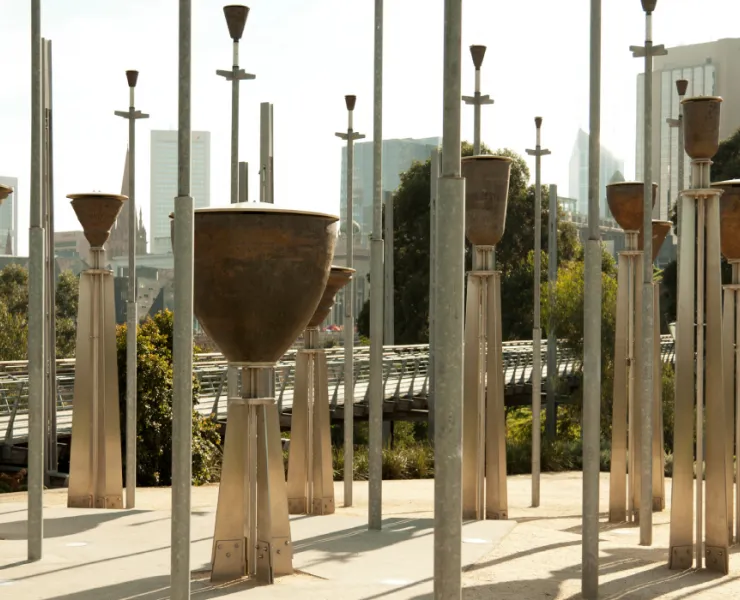
The Federation Bells have a pitch range of four octaves, from D2 (two octaves below middle C) to D6 (two octaves above middle C). This corresponds to a frequency range from 73 Hertz (i.e. 73 sound wave cycles per second) up to 1172 Hertz.
Unlike most Western instruments in use today, the Federation Bells are just tuned. This is a tuning system that follows the harmonic series that exists in nature, and has been in use for 5000 years. Rather than dividing every octave into 12 equal divisions (as is done with the equal-tempered tuning system we are used to hearing), just tuning intervals are derived from frequency ratios of a fundamental pitch.
In the case of the Federation Bells, the fundamental pitch is a D (or 73 Hertz in the lowest octave of the Bells). A ratio of 2/1 represents one octave above (i.e. D3 or 146 Hertz). Other ratios used in the Federation Bells are 3/2, 4/3, 5/3, 5/4, 7/4, 6/5, 7/5, 8/5, 9/5, 9/8 and 15/8. The absolute frequencies and the “notes” that they correspond to are listed in the information table below.
Note that in some cases the just tuning ratio and the equal temperament tuning is almost identical. For example, the ratio 3/2 (used in Bells 2, 6, 21 and 33) is almost identical to an interval of a fifth above the fundamental (‘A’ in the case of the Federation Bells).
However, for other intervals, the ratio varies significantly from its equal tempered equivalent. For example, the ratio 7/4 (used in Bells 7, 10, 24 and 36) roughly corresponds to a minor/dominant 7th above the fundamental (i.e. ‘C’ for the Federation Bells), but it is 31.2 cents below an equal tempered ‘C’. In other words, it is almost one-third of a semitone flat compared to an equal tempered instrument.
For the uninitiated this all simply means that the Federation Bells have a unique sound and that music created for the Federation Bells must be composed with this tuning system in mind. Many modern-day Western songs or tunes would not sound particularly effective performed on the Federation Bells; however, conversely, the tuning system of the Federation Bells opens up possibilities that are not achievable on other instruments.
Most of the Federation Bells are harmonic bells. Seven bells are polytonal bells External link, meaning that they are tuned to play more than one pitch with each strike. The table shows that bells 9 to 14 are two-tone bells and bell 8 has three distinct frequencies. These bells give the impression of a musical chord.
The harmonic bells External link are very pure in the tone compared to other bells. Each bell is tuned to seven harmonic partials, meaning that the fundamental pitch of the bell can be clearly perceived.
Contact us
City of Melbourne Curator

