Graffiti removal
Unauthorised graffiti is illegal everywhere in Australia. City of Melbourne removes graffiti from all non-council public property, except for Yarra Park and the Melbourne Cricket Ground.
If you’ve spotted obscene or offensive graffiti, please call us on 03 9658 9658 for fast-tracked removal.
Report unwanted graffiti
Report graffiti directly to City of Melbourne in just a few taps using the free Snap Send Solve app for iOS External link and Android External link devices.
It's the fastest way to let us know and we'll send updates as we handle your report.
Get the app and start snapping.
Download from the App Store External link Download from Google Play External link
You can also report graffiti using our online form below.
Submit a graffiti report
Removal of graffiti from private properties
Under section 18 of the Graffiti Prevention Act 2007 the City of Melbourne will write annually to property owners / managers / occupiers detailing the consent to remove illegal graffiti from private properties.
The terms and conditions below provide property owners with information required to decide whether to opt out from allowing City of Melbourne to remove graffiti from the outside of their properties.
- Definitions: in these terms and conditions a reference to:
- ‘Opt out’ means notifying the Council that property owners object to the Council removing graffiti from the outside of their property that is accessible from a public place.
- ‘Public place’ has the same meaning at the Melbourne Activities Local Law 2019.
- ‘We’, ‘us’, ‘our’, ‘Council’ or ‘City of Melbourne’ means the Melbourne City Council trading as the City of Melbourne including its employees, contractors and agents.
- ‘Property owner’ or ‘property owners’ is a reference to a person who has received the notice from the Council under section 18 of the Graffiti Prevention Act 2007.
- What action will we take if property owners do not opt out? City of Melbourne will remove any graffiti from outside properties that is reported to us, or that we become aware of from time to time. However, we will only remove graffiti that can be reached without entering the property. For example: graffiti that is on a wall or fence that can be accessed from the street or public place.
- How can property owners arrange for removal of graffiti that cannot be reached from a public place? If there is graffiti on your private property that cannot be removed from the street or a public place, then you will need to contact a graffiti removal service provider independently of council.
- When will we remove graffiti from properties? If a property owner does not opt out, then the City of Melbourne will remove graffiti that is located on the outside of the property that is reported to us, or that we become aware from time to time/
- How is graffiti removed? Graffiti removal methods can include high pressure washing, painting over using colour-matched paint and chemical removal. Risk assessments are conducted in the graffiti removal process to minimise the risk of damage to the property or surrounding areas.
- Important information: If a property owner does not opt out, then we will remove any graffiti that is reported to us, or that we become aware of, from the outside of properties in the manner described above, but only where we can do so from the street or a public place. We will seek to ensure that we remove any graffiti using reasonable care and to a reasonable standard. However, under the Graffiti Prevention Act 2007, no compensation is payable in respect of any loss, damage or injury to property, resulting from or arising out of any act or omission done in good faith for, or on behalf of the City of Melbourne.
- How can property owners opt out? To opt out, please contact City of Melbourne’s Customer Service Centre within 10 business days of receipt of the notice. This can be done by email: enquiries@melbourne.vic.gov.au or by phone: 03 9658 9658. Property owners can also opt out at any time in the future, however, after the 10 days have elapsed, the City of Melbourne may remove any graffiti on the outside of properties, until we are contacted.
- What happens if property owners chose to opt out? Council will not remove graffiti from the outside of these properties. It will be the responsibility of the property owner to do so in a timely manner, unless the Council has issued a permit to display street art under clause 4.2 of the Melbourne Activities Local Law 2019. If any graffiti is not removed from the property within a reasonable period of time, then the City of Melbourne may issue a notice requiring the property owner to do so in accordance with clauses 4.3 to 4.5 of the Melbourne Activities Local Law 2019.
Victims of graffiti crime – guidelines
The guidelines below provide victims of graffiti crime with information on pursuing criminal proceedings, preparing Victim Impact Statements and obtaining compensation.
The Graffiti Prevention Act 2007 (Graffiti Act) governs graffiti related offences. Under the Graffiti Act, graffiti means ‘to write, draw, mark, scratch or otherwise deface property by any means so that the defacement is not readily removable by wiping with a dry cloth’. This includes tags and stencil drawings (collectively called marks or markings). It is an offence to mark graffiti on property unless the owner or owners’ representative has provided consent.
Graffiti that would offend a reasonable person is not allowed, even with the owner’s consent.
Graffiti that is applied to a property from a public place or graffiti that is visible to the public may require permission from council and the property owner.
Victoria Police investigate and prosecute graffiti offences. A breach of the Graffiti Act is a criminal offence. If you see someone marking graffiti you can report this by calling 000. If graffiti has been marked on your property but you didn’t see it happen, you can report this by calling 131 444 or report it online External link.
It is also an offence under the Melbourne City Council Activities Local Law 2024 to apply or allow street art on private property that can be seen a public place, without first obtaining a permit from the Melbourne City Council. Council’s authorised council officers can enforce this.
Yes, the City of Melbourne provides a graffiti removal service to residents and businesses and the City of Melbourne will removal graffiti where it can be done from the street or a public place. Consent is required from property owners or occupiers before graffiti can be removed from private property.
You can report unwanted graffiti to have removed.
You can read more about Council’s Graffiti Management Policy.
The police must have evidence that meets the criminal threshold of ‘beyond a reasonable doubt’ to obtain a conviction.
If the graffiti is on property that you own, you can support the police investigation by:
- taking photographs of the damage
- saving relevant camera footage
- asking your neighbours if they witnessed the crime, and recording their name and contact details if they did
- keeping invoices for any work to remove the graffiti
- making note of any personal impact to you as a result of the graffiti.
If there is sufficient evidence to identify and locate the person accused of a graffiti offence, then the property owner may be able to make a claim to be reimbursed for any financial costs incurred to remove the graffiti.
If the graffiti offender cannot be identified or the evidence is insufficient, the police will not be able to prosecute and/or you will not be able to recover any costs.
If you are the owner or occupier of private property that has been marked by graffiti, and a person is identified as the offender, charged by the police and found guilty, you may be able to:
- Prepare a Victim Impact Statement to be given to the court.
This is a document that allows you to tell the court what impact the crime has had on you and may be used by the Magistrate when sentencing the offender. - Ask the police to seek a compensation order under section 86 of the Sentencing Act 1991 for compensation (not greater than the value of the property lost, destroyed or damaged).
You will only be entitled to a compensation order if you have incurred financial loss or damage to property as a direct result of the crime and if the Court decides it is reasonable to make a compensation order. If the City of Melbourne has removed the graffiti, the City of Melbourne has incurred the cost, not the property owner.
The Court is required to take into account the offenders’ financial circumstances and ability to pay, before making a compensation order.
Information about Victim Impact Statements can be found on the Victims of Crime website External link.
There is no set way to prepare a Victim Impact Statement, but every statement must have a statutory declaration at the end.
A template Victim Impact Statement (DOCX 741 KB) External link is available on the Victims of Crime website.
The Victims of Crime helpline 1800 819 817 can provide information, advice and support when writing a Victim Impact Statement.
Where the plea hearing fits in the court process
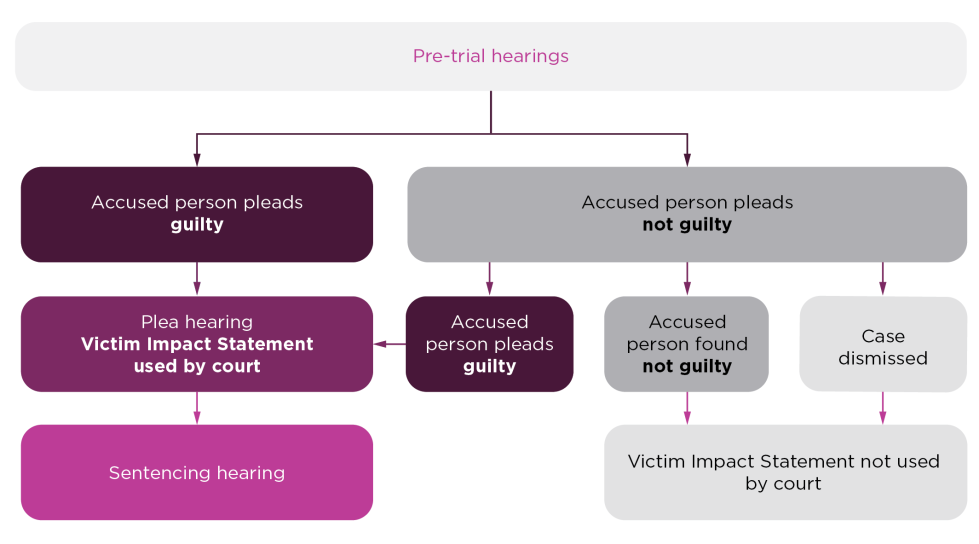
For more information and to download a larger diagram, visit How Victim Impact Statements are used at Court - Victims of Crime website External link
Image description
As part of pre-trial hearings, the accused person either pleads guilty or not guilty.
- If the accused person pleads guilty:
- There will be plea hearing which includes the Victim Impact Statement used by court, then a sentencing hearing.
- If the accused person pleads not guilty:
- If they are found guilty, there will be plea hearing which includes the Victim Impact Statement used by court, then a sentencing hearing.
- If they are found not guilty, or if the case is dismissed, the Victim Impact Statement is not used by court.
If an accused is found not guilty or is not charged for an offence, the court will not consider your Victim Impact Statement and the police will be unable to seek a compensation order on your behalf. If the identity of the graffiti offender is known, and you have incurred costs, you may be able to take civil action.
The identity of an offender is required in order to take civil action to recover any costs incurred by you.
If a compensation order is made to reimburse you of any costs, the court will indicate where the money is to be paid. If the offender fails to pay a compensation order, you will need to enforce the debt at the court. This will usually be at the Magistrates Court and is known as a civil proceeding. You may need to obtain your own legal advice.
Current system for making and enforcing restitution and compensation orders
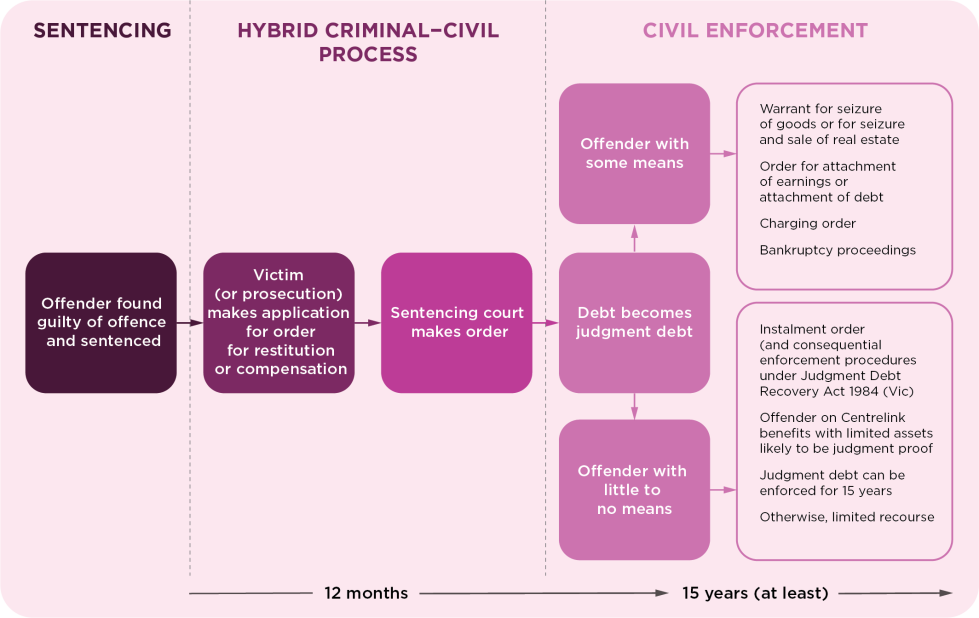
Image description
The system includes 3 phases: sentencing, a hybrid criminal-civil process, and civil enforcement
- At the sentencing stage, the offender is found guilty of the offence and sentenced.
- The hybrid criminal-civil process follows the sentencing. This process takes 12 months and comprises the following:
- Victim (or prosecution) makes application for order for restitution.
- Sentencing court makes order.
- The civil enforcement stage follows the hybrid criminal-civil process and can take at least 15 years. During this stage:
- The debt becomes judgement debt.
- Then, if the offender has some means:
- Warrant for seizure of goods or for seizure and sale of real estate
- Order for attachment of earnings or attachment of debt
- Charging order
- Bankruptcy proceedings
- If the offender has little or no means:
- Instalment order (and consequential enforcement procedures under Judgement Debt Recover Act 1984 (Vic))
- Offender on Centrelink benefits with limited assets likely to be judgement proof
- Judgement debt can be enforced for 15 years
- Otherwise, limited recourse
If you have incurred costs to clean and/or remove graffiti from your property you may be able to sue the offender (if the offender is identified) through civil proceedings – this is known as a 'damages claim'. If the City of Melbourne has removed the graffiti, you will not have incurred the cleaning/removal costs.
Depending on the value of the repairs or cleaning costs, you will have to issue civil proceedings at the Magistrates Court (for claims up to $100,000) or at the County Court (for claims above $100,000).
Graffiti vs street art
Graffiti is the marking of another person’s property without permission. Graffiti can include tags, stencils, pieces and even colourful murals which have been done without the permission of the person who owns the space.
Street art is artistic work created with the permission of the person who owns the wall. With proper permission, street art is legal in the City of Melbourne. Written permission is required from the building owner and a planning permit may also be required for properties in a heritage control area.
Subject to budget, we may occasionally commission street art to brighten up dull spaces.