

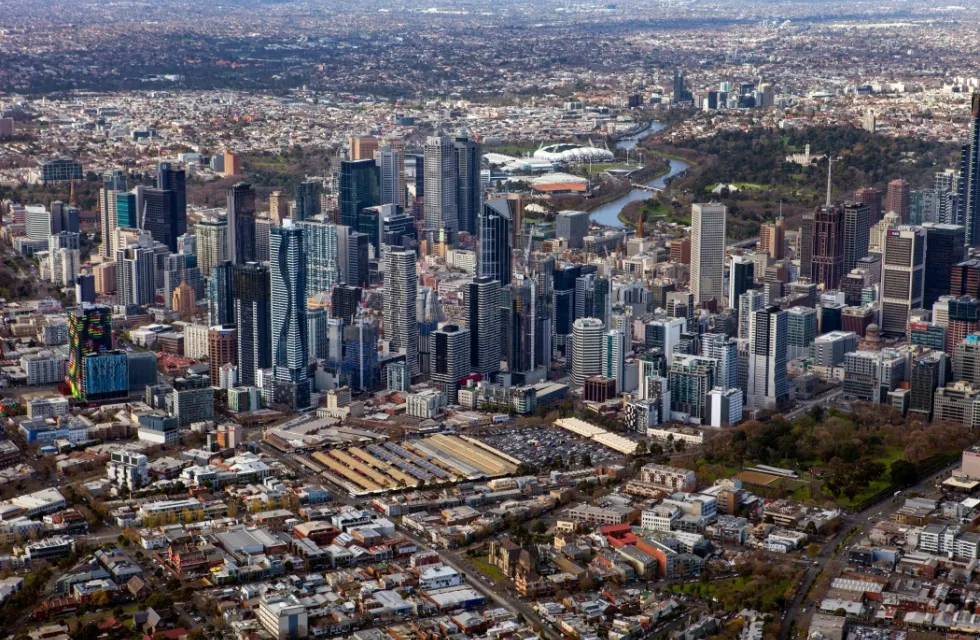
On Friday 9 May, over 700 proud and passionate Melburnians gathered at Melbourne Town Hall for the M2050 Summit. The summit generated a wide range of ideas and highlighted many shared perspectives across our community. We are pleased to share the M2050 Summit Report – a summary of the event and the collective insights contributed by participants, on the day.
Watch the videos
M2050 Summit Event Day
Lord Mayor, Nick Reece: Welcome to the biggest Town Hall meeting that this city has ever seen, the Melbourne 2050 Summit. We are asking the big questions. What should Melbourne be like in the year 2050?
Councillor Andrew Rowse: So exciting to have so many people coming in today to hear all of their thoughts, to hear their concerns, to hear their dreams, their visions.
Ahelee Rahman: Events like this are important because it brings people together, across industry, across community, across stakeholders, and it really forces us to think about long-term vision.
Speaker 4: I'd like to see a vibrant city like it is already, but even more vibrant like.
Speaker 5: I'd like to see, like an advanced, modern city where, like, it could be a nice window for the world.
Speaker 6: I'm really hoping to understand from other people what we can do together as a community to help support the vision of everyone else in the city.
Speaker 7: I love to see the city engaging with different entrepreneurs like myself to ask good questions and get good answers.
Alison Leighton: I was so struck by the intellect, the passion, the purpose, the desire for Melburnians to be involved in a conversation about our city's future, it was extraordinary.
Speaker 9: I hope that from today we can see a future plan for Melbourne that is led and designed by communities, for communities.
Evan Counsel: I really loved some of the leadership and democracy about leading with hope, not fear, and hearing from our youth throughout the day was incredibly powerful.
Speaker 11: It's imperative that our vision for 2050 is both inclusive and forward thinking.
Lord Mayor, Nick Reece: It's been a day full of ideas. It's also been a day when we have renewed the promise of Melbourne, a city where every person can live their absolute best life.
Tim Moonen: In 2050, Melbourne will be one of 800 cities larger than one million people.
That's more than twice the number that we had at the start of the century.
And even as population growth, as we see, is now slowing down worldwide, by pretty much any forecast, it's cities that will be the magnets for trade, for entertainment, for ideas and for opportunity, but these roles come now layered with new risk and added anxiety, whether you call it the poly crisis or the vibe session, no city's job space or wellbeing will be unaffected by what's ahead of us in AI, in geopolitics and in climate.
In 2050, we'll probably be talking about those cities who will have emerged from this period as relative winners and others the losers of status, population and vitality.
And so in this context, it's quite likely that, especially for the trademark liveable cities like Melbourne, that they'll be held up against whether they fulfilled their promise as upholders of the city, as a public good.
In other words, their appeal and their reputational advantage will derive in future, not just from their lifestyle but their fairness, on belonging, on reconciling the city with nature, on how they integrate technology so that urban living is enriching and embodied and not automated and polarising.
So what might this mean for the kind of city in practice that we'll see come 2050?
To me, I think three things come to mind.
The first and most obvious direction is that city centres and inner cities will have a much better mix of uses and activities, making the city easier and more enjoyable, but also more flexible, more ready for the unexpected.
That means adapting land uses and buildings where possible, but also place making for a city that's more active, more healthy, more convivial.
Second, I think those inner cities will still serve as the stage for what we call the intangible economy.
That's the economy fuelled by software, IP, trust, collaboration, stories, but their growth will also depend on a material backbone of energy, of data and production, much of which is likely to cluster elsewhere.
So inner cities will not succeed simply as ivory towers of knowledge or as islands of celebration and consumption.
Instead, they'll be dialled into whole ecosystems beyond their boundaries, as well as within specific districts inside them.
Third, the benchmark cities in 2050, I think, will have forged a much stronger kind of social contract and consensus on what a good city is, what good growth really looks like.
No city that we can see will succeed just by serving the high skilled or the well paid.
They'll work just as well for the very old and the very young, as they do for tourists and professionals.
They'll have unfailing public services. They'll have a more viable mix in their housing supply.
So the liveable cities that do those three things well, I think, will avoid the fate that others look destined for.
Being chronically unaffordable, unattainable or even undesirable.
The cities that get there will have to have the spirit and the place leadership that's optimistic and that's inventive.
They won't stand still. They won't be self satisfied.
They won't be paralysed, either by process or by indecision.
Instead, they'll have a dialogue.
They'll have a direction about what's at stake for their future, and they'll have figured out how it is that they work well with their neighbours and negotiate their needs collectively with government.
And that's why it's so important that a city like Melbourne engages with its whole community to develop a long term horizon, a common purpose, we might call it, a shared language.
Other cities show us all of the time why that's important.
Let's take Stockholm, a place I was in just last week.
Its own 2040 vision, called a City for Everyone, committed that city to put innovation in service of people and planets.
And one result we already see there is that Stockholm's pound for pound, the home to the most venture capital going into purpose driven companies, those firms whose mission it is to change the world for the better.
In Japan, it's the city of Fukuoka where it's really grown its population and startup base faster than anywhere else outside Tokyo these last 10 years, and that's been underpinned by a North Star leadership vision that treats venues for civic participation, as part of the engine of change.
Lisbon. Lisbon made sure that when it became Europe's most improved city for scale ups, that it partnered with the innovators that it attracted on the city's own processes and started engaging citizens throughout the public policy life cycle.
And across in India, you see in Hyderabad, emergence as India's most improved tier one city that's been put down in very large part to its ambition to be more transparent and easier to engage with. Now, creating a single services map for citizens and agencies alike is just one example.
Now these are very different cities, very different contexts, but they all give a flavour of the thrust of long term vision cities are heading towards.
Bold in ambition, synchronised in their social and economic goals, looking outwards and to their neighbours as well as inwards, and pursued through various collaborative forms of leadership and convening.
Melbourne, I think, can learn from the world, but also inspire the world in the way that it chooses to navigate these 25 years ahead.
Dr Sonja Hood: I think Melbourne's got some amazing advantages. It starts out by being the best city in the world, so that's a pretty decent starting point.
Chris Lucas: We're an amazing multicultural city, and that's reflected in the vibrancy and the color and the energy of our food sector.
Paul Waterson: We have incredible number of events, major events here in Melbourne. It's important we continue to be seen as the event capital of Australia and the world, incredible sporting precincts and an amazing partnership with government and operators within this business and in particular in my sector that we just don't see elsewhere in Australia.
Russel Howcroft: Well, Melbourne's always been heavily advantaged. It's been heavily advantaged for a really simple reason the grid, the Hoddle Grid, which is, there's a picture there of the Hoddle Grid. I've always thought that the core to Melbourne was just the way we were set up.
Sally Capp: We're just so fortunate in Melbourne to have so many positive factors that have driven our growth to date and give us a wonderful sense of optimism for the future. For me, at the very centre of that is people. Cities really are about people. Cities should reflect the ambitions and the aspirations and the values and beliefs of people.
Dr Jill Gallagher: I think it's important for Melbourne to not lose its deep history to an ancient culture also, you know, Melbourne didn't start 250 years ago. It started well before then but how can we meld the two together? I think that's the important thing. How do we bring along that ancient culture along with a modern Melbourne?
Russel Howcroft: We've got to make sure that we preserve the street life that we've got and and really enhance it, actually. Yeah, we can probably do a better job there. But the street life of Melbourne now is way better than it was, you know, 20 years ago, 30 years ago for sure.
Bernard Salt: We celebrate diversity, ethnicity diversity in particular, and I think we need to continue along that theme over the next 20 years or so.
Paul Waterson: I think other things, you've got unique architecture. Many of our pubs are over 150 and 160 years old and operated in same location for that journey. And there's not many businesses that have operated in that same place for so long. So it's really critical we work together to retain those.
Virginia Trioli: I'd like Melbourne to have worked out a way to sustain the population growth that we continue to have here in a way that still makes this city pleasant for everybody.
Bernard Salt: By 2050 I fully expect Melbourne to be the largest city on the Australian continent, to have regained its title as the largest city on the Australian continent. And I think it's an opportunity to look at Melbourne as a leading city, the leading portal to the Australian economy, to the Australian people.
Chris Lucas: The one thing that I could say there are many, many things that I would like to see our city to be in 2050 but one of those things is, I'd love to be able to see our city to be a 24/7 city. And I think if we can have a city that has an amazing population growth, but also can draw tourism around the world, because it is a 24/7 city, I think, you know, we'll have something we can be all very proud of.
Russel Howcroft: I want people to be jealous. I want them to live here. I want the very, very, very, very best people in the world, the biggest brains, the smartest people, the most creative people.
Paul Waterson: I would like to see Melbourne be one of the world's most exciting drinking and dining destinations, essentially the best in the southern hemisphere, rivalling places like Berlin, New York, London.
Sally Capp: In 2050, I hope that Melbourne is the happiest of cities around the world. We often talk about big buildings or big tourist attractions, or we point to numbers that come from economic prosperity, or even numbers of people. I think we'll know that we've got all of those elements right, if people are happy,
Dr Sonja Hood: I think that we have an opportunity to be all things as a city, not somewhere that you just visit or come to work, but somewhere where you live and you eat and you play and you get your culture and you participate in whatever way that means for you.
Dr Jill Gallagher: That's what I would like to see. And I would love to see Melburnians value that they belong to this continent and to this culture also.

